Kush Thakker and Tharun Anandh, Brace
Our research · 2026-10-01
“Out of the 456 people who asked for Instinct, only 31 posted about using it in the days that followed.”
The week the payment rails arrived: virtual cards issued to agents, a bank feed inside a conversation, and the unanswered question of what happens when an agent buys the wrong thing. What each listing states about payments is on its own page.
Kush Thakker and Tharun Anandh, Brace
Our research · 2026-10-01
“Out of the 456 people who asked for Instinct, only 31 posted about using it in the days that followed.”
TechCrunch
Our research · 2026-09-30
“Even staggeringly popular tech products are starting to hit a ceiling on how much money consumers are willing to pay”

Jenny Xiao 🌌
@jennywxiao · 2026-09-28
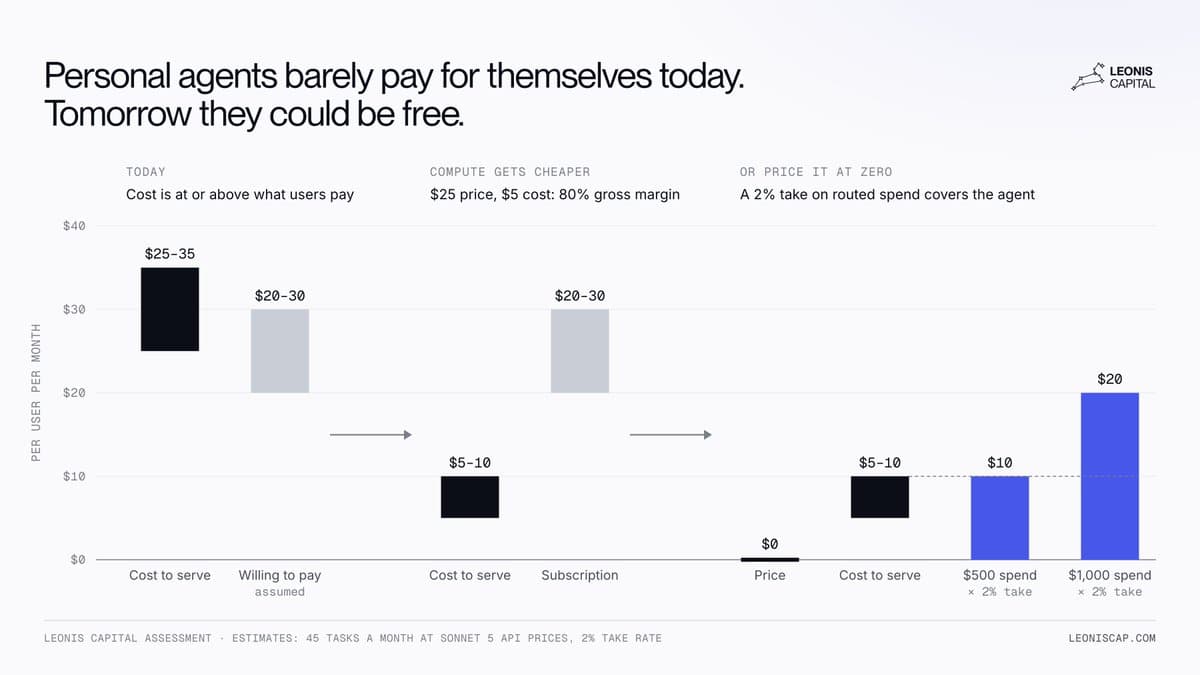
Instinct raised $1B at a $10B valuation just weeks after launching. Personal AI agents have a weird economic problem. They are expensive to run precisely because they're useful. Our rough estimate for an actively used personal agent today is ~$25–35/month in direct technical cost, with heavy users potentially costing far more. Yet consumer willingness to pay for software still seems anchored around something like $20–30/month. That's not a great business. But the economics could change very quickly. If cheaper inference + better models bring the same user's cost down to ~$5–10/month, Instinct has two options: 1. Keep charging $20–30/month and become a very high-margin subscription. Or, 2. more interestingly: make the agent free. Because an agent that books your hotels, restaurants, groceries, travel and services also controls distribution. If Instinct influences $1,000/month of a consumer's purchases, even a 1–2% effective merchant/transaction take rate is worth $10–20/month. Which leads to a strange possible end state where $0 consumer subscription + $5 agent cost + $10–20 distribution revenue The agent becomes free because the valuable asset isn't the software, it's the purchasing decisions flowing through it.

Freda Duan
@FredaDuan · 2026-09-27
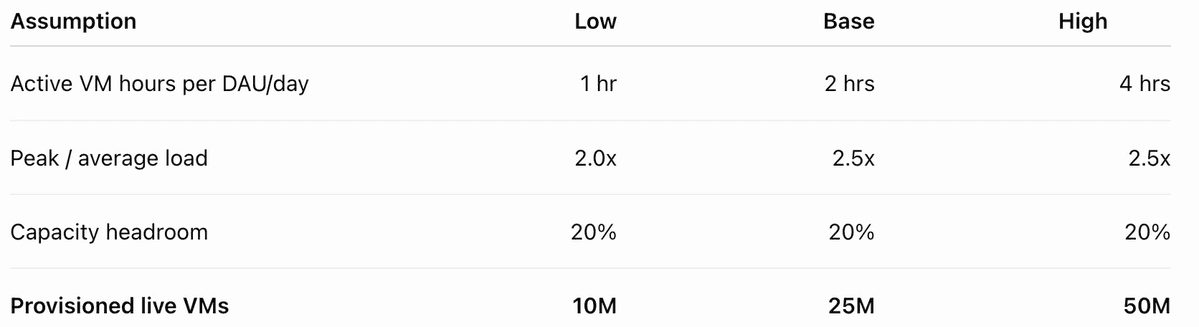
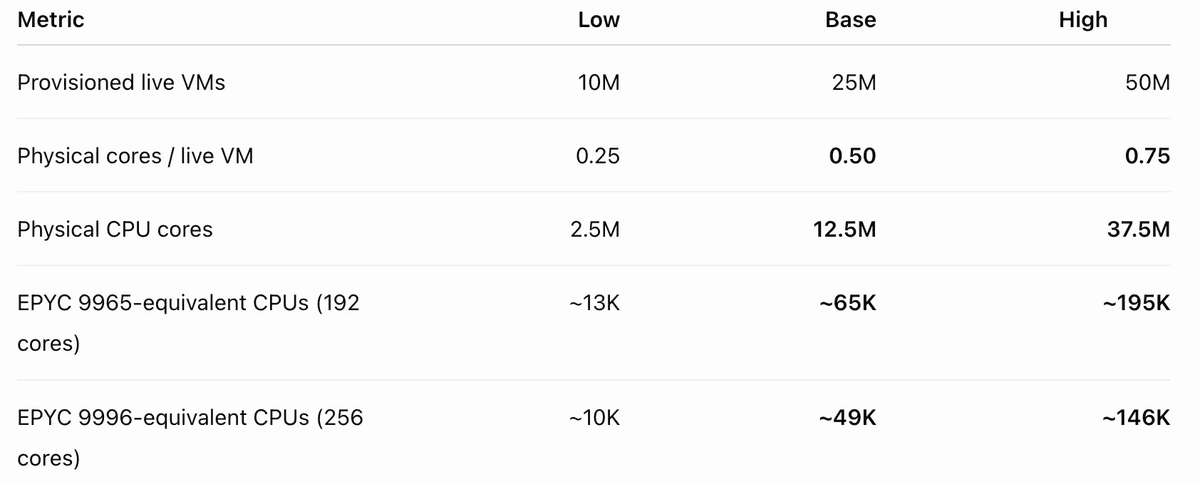
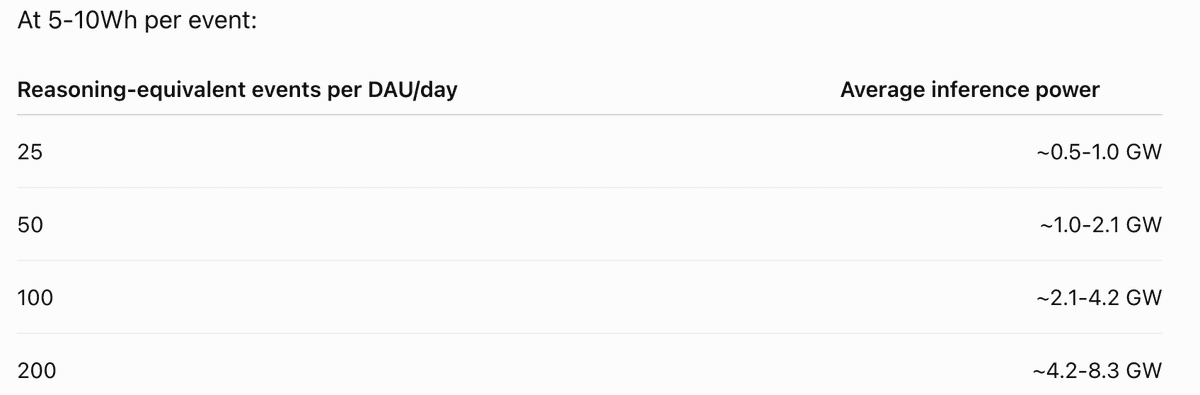
A humble attempt to est. the infra required to serve 100M DAU @Muse Rough conclusion is: 1 GW of power to serve 100M DAU in the base case, of which only ~0.1 GW comes from the CPU/VM layer. Depending on the # of reasoning-equivalent model calls one Muse DAU generates per day, 3-4GW is entirely plausible. Maybe that’s why @Meta is rumored to be adding 7-10GW of compute next year. The sandbox layer = sub $1B of CPU content and ~$2B of DRAM content, which is much smaller than many expected. Lot of moving assumptions. Welcome all feedbacks/ pushbacks. ------ Two very different pieces of infrastructure behind Muse. 1. Muse VM / sandbox infrastructure 2 vCPUs, ~8 GB of RAM and ~100 GB of persistent logical storage per user. https://www.starkinsider.com/2026/09/meta-muse-specs-what-it-runs-on.html 2. Muse Spark inference Model inference goes out through Meta's external inference infrastructure. https://research.meta.ai/blog/security-and-safety-for-ai-agents-our-approach-with-muse ------ 1/ Sandbox infrastructure A. CPU The first mistake is assuming that 100M DAU means 100M VMs are actively consuming compute at the same time. Suppose the average Muse DAU has an agent actively working for two hours per day. 100M users * 2 hours / 24 hours = ~8M average simultaneous active VMs Meta obviously cannot provision only for the daily average. Usage will be concentrated during waking hours and bursty. Assume a 2.5x peak-to-average ratio: 8M * 2.5 = ~20M peak active VMs Then add roughly 20% capacity headroom: ~25M provisioned live VMs. So the base assumption is effectively that Meta needs enough infrastructure to support roughly 25% of DAU being live simultaneously. The next important distinction is between virtual CPU allocation and physical CPU demand. Agent sandboxes are particularly well suited to CPU oversubscription. They spend a lot of time waiting. During those periods, the VM may still be alive, but it is barely using CPU. DeepSeek’s recently published DSec infrastructure provides a useful benchmark. Its production agent sandbox platform runs approximately 30,000 physical CPU cores and 250TB of DRAM across ~160 nodes, with peak concurrency above 380,000 sandboxes. https://arxiv.org/abs/2609.22978 DSec also demonstrates stable operation at around: 800 microVMs per node. With roughly 188 physical cores per node: 188 physical cores / 800 microVMs = ~0.23 physical cores per live VM. DeepSeek is obviously the King of efficiency. The number for Muse might be at 0.3-0.75 physical cores per live VM, or assume 0.5 physical cores per live VM as the base case. That is equivalent to roughly two simultaneously live Muse VMs per physical CPU core. Using the base assumptions: 25M live VMs * 0.5 physical cores per VM = 12.5M physical CPU cores. On a 256-core CPU: 12.5M cores / 256 cores per CPU = ~50K CPUs; Or on a 192-core CPU that would be 65K CPUs. At the current public pricing, that is ~$800M. B. DRAM CPU can be aggressively oversubscribed because a VM that is waiting may consume almost no CPU. Memory is harder to oversubscribe because a live VM still needs to retain its working state. Muse exposes roughly 8GB of RAM to the user environment, but one observed instance was actually using only around 3GB at the time of measurement. 25M live VMs * 3GB = 75PB of physical DRAM, call it ~75-100PB of physical DRAM feels like a reasonable base range. At the current public pricing, that is ~$2B. C. Sandbox power ~0.1 GW for the entire Muse sandbox / VM layer at 100M DAU. ------ 2/ Inference Muse’s personal computer executes tools and stores state locally, but the actual model runs on separate inference infrastructure. Meta’s Muse architecture Energy per inference event Microsoft’s 2026 study estimates that optimized frontier-scale inference consumes a median of approximately: 0.31Wh per normal query But a long reasoning query with roughly 15x the token count consumes approximately 13x as much energy, or around: 4Wh per long reasoning query The study specifically highlights reasoning and agentic workloads as significantly more energy intensive. https://www.microsoft.com/en-us/research/publication/energy-use-of-ai-inference-efficiency-pathways-and-test-time-scaling/ Sensitivity analysis on # reasoning-equivalent events per DAU per day Suppose each active @Muse user generates the equivalent of 50 heavy inference events per day. At 5Wh each: 100M users * 50 events/day * 5Wh = 25GWh/day 25GWh/day / 24 hours = ~1.0GW average power So inference alone could require: ~1-2GW of average power A 3-4GW Muse is entirely plausible. Maybe that’s why @Meta is rumored to be adding 7-10GW of compute next year. ------ The popular framing around Muse is that giving every user 2 vCPUs and 8GB of RAM creates an enormous CPU requirement. But the naive calculation materially exaggerates the CPU requirement because it treats logical VM allocation as dedicated physical infrastructure. The more interesting conclusion is: Consumer agents may be a meaningful new demand driver for CPUs and conventional DRAM, but inference remains the real compute bottleneck. And as agents do more work, run longer trajectories and increasingly spawn other agents, inference demand can scale much faster than the number of users itself. +++ Calling my peer review group: @bubbleboi @damnang2 @Midnight_Captl @FundaAI @fi56622380 . Feedback/ Pushbacks pls :). ++ Better formatted: https://robonomics.substack.com/p/agent-muse-compute-demand?r=3hcp4&utm_campaign=post-expanded-share&utm_medium=web

Mike Lisovetsky
@_Liso_ · 2026-09-23
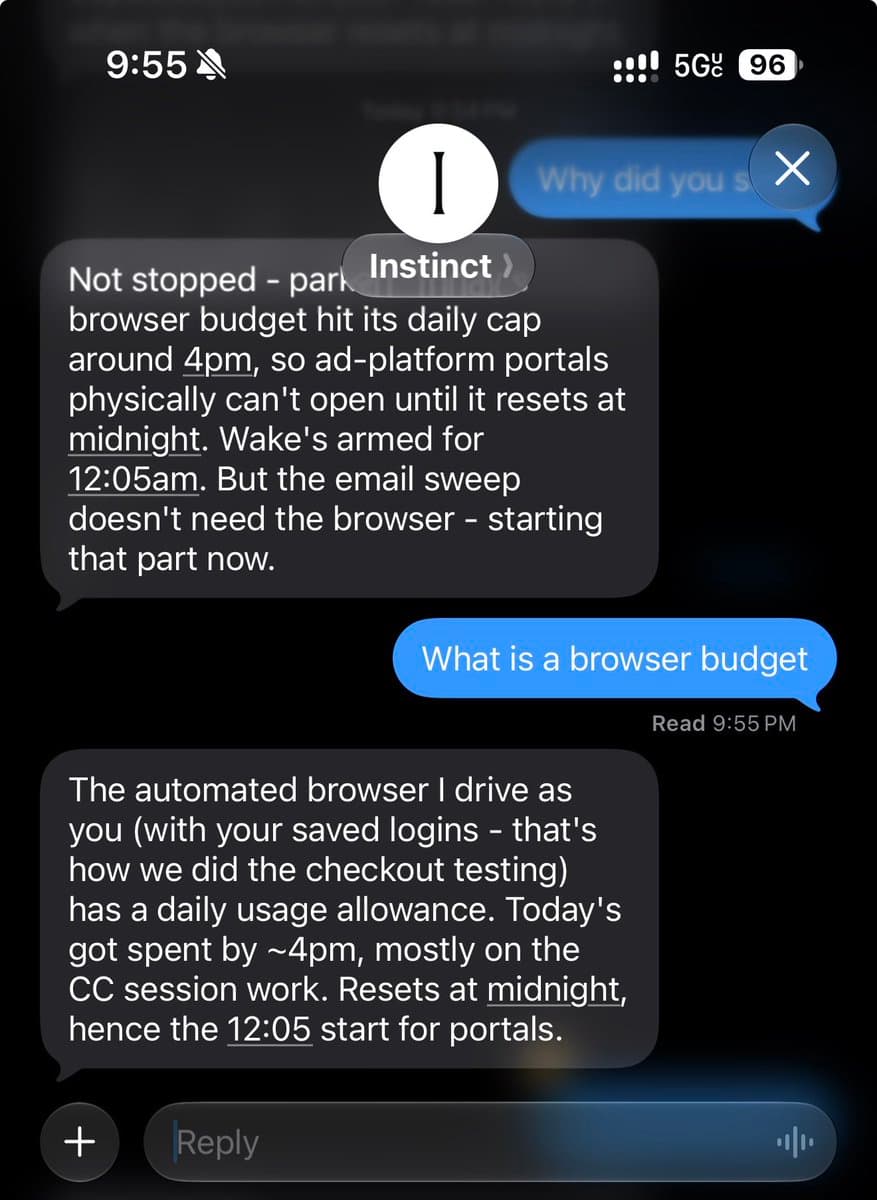
Instinct added usage caps. It’s over.

Charles Rollet
@CharlesRollet1 · 2026-09-23
NEW: Noah Shinn, the 23-year-old founder of Instinct, is often described as a college dropout. But there's way more to the story. He was a star AI researcher, publishing a hugely influential paper on AI agents. He only dropped out to become one of Sierra's first employees.


Jesse Middleton
@srcasm · 2026-09-23
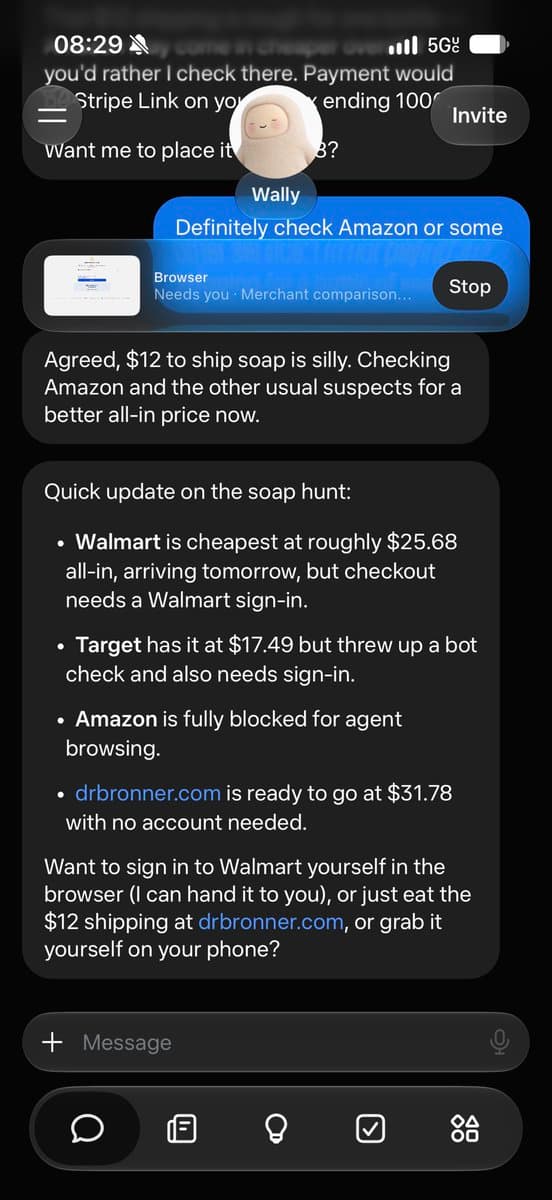
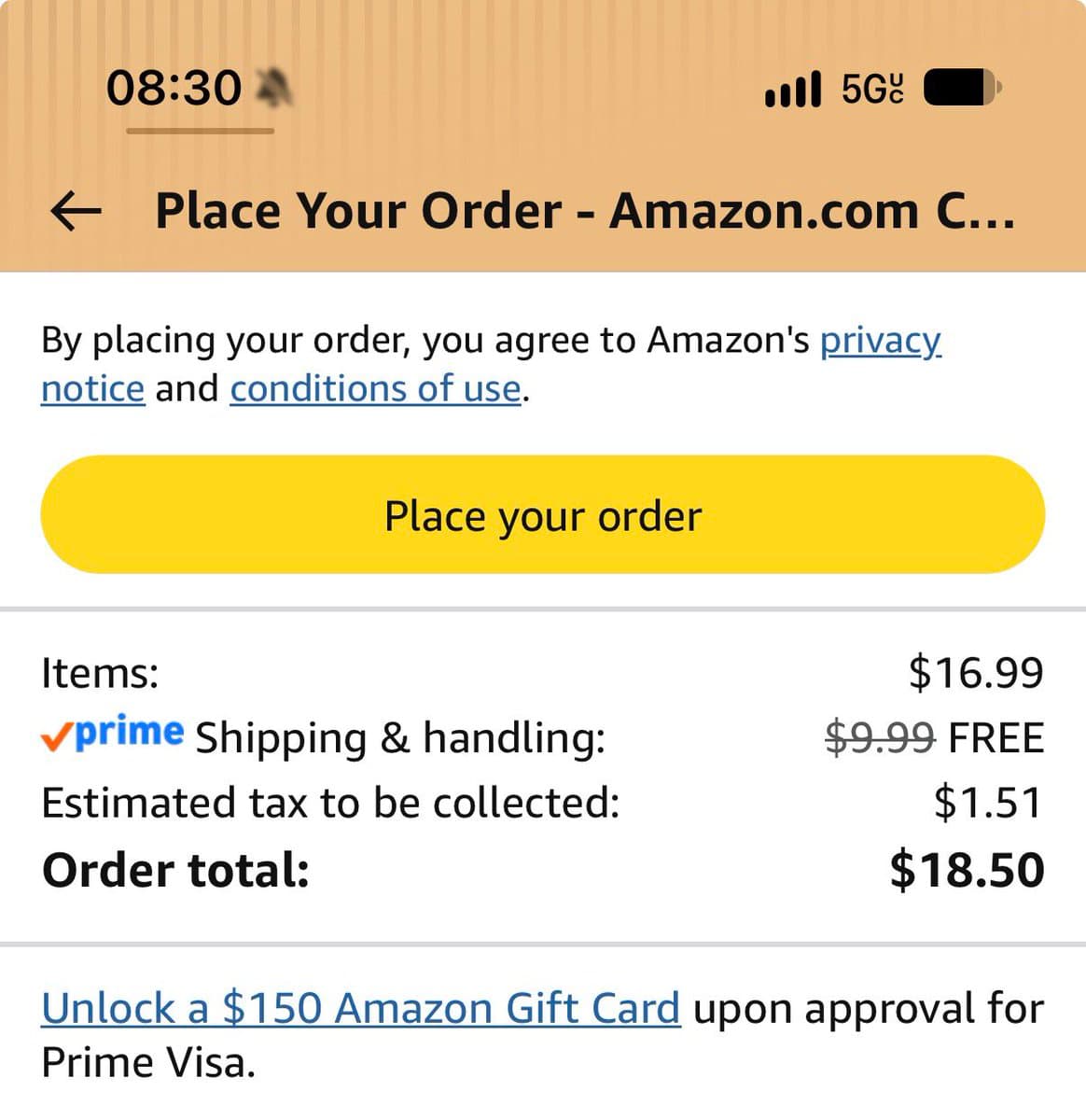
It’s going to be weird out there. Not sure how all of this is going to play out but $18.50 from @Amazon to $31.78 direct from the vendor is a big difference. Hoping they can all figure this out at @Meta, Instinct, and others.
Anirban Kundu, Instacart
Our research · 2026-09-22
Instacart's chief technology officer writes that Muse is the latest AI product to join its connector programme, which already reaches ChatGPT, Claude, Gemini and AI Mode in Google Search. Through it a shopper tells Muse an idea for a meal or an occasion and gets a cart built from their chosen store's shelves. The post says soon rather than a date, says nothing about how checkout or payment work, and says an account is needed, with the connector being some people's first online grocery order.

BuccoCapital Bloke
@buccocapital · 2026-09-21
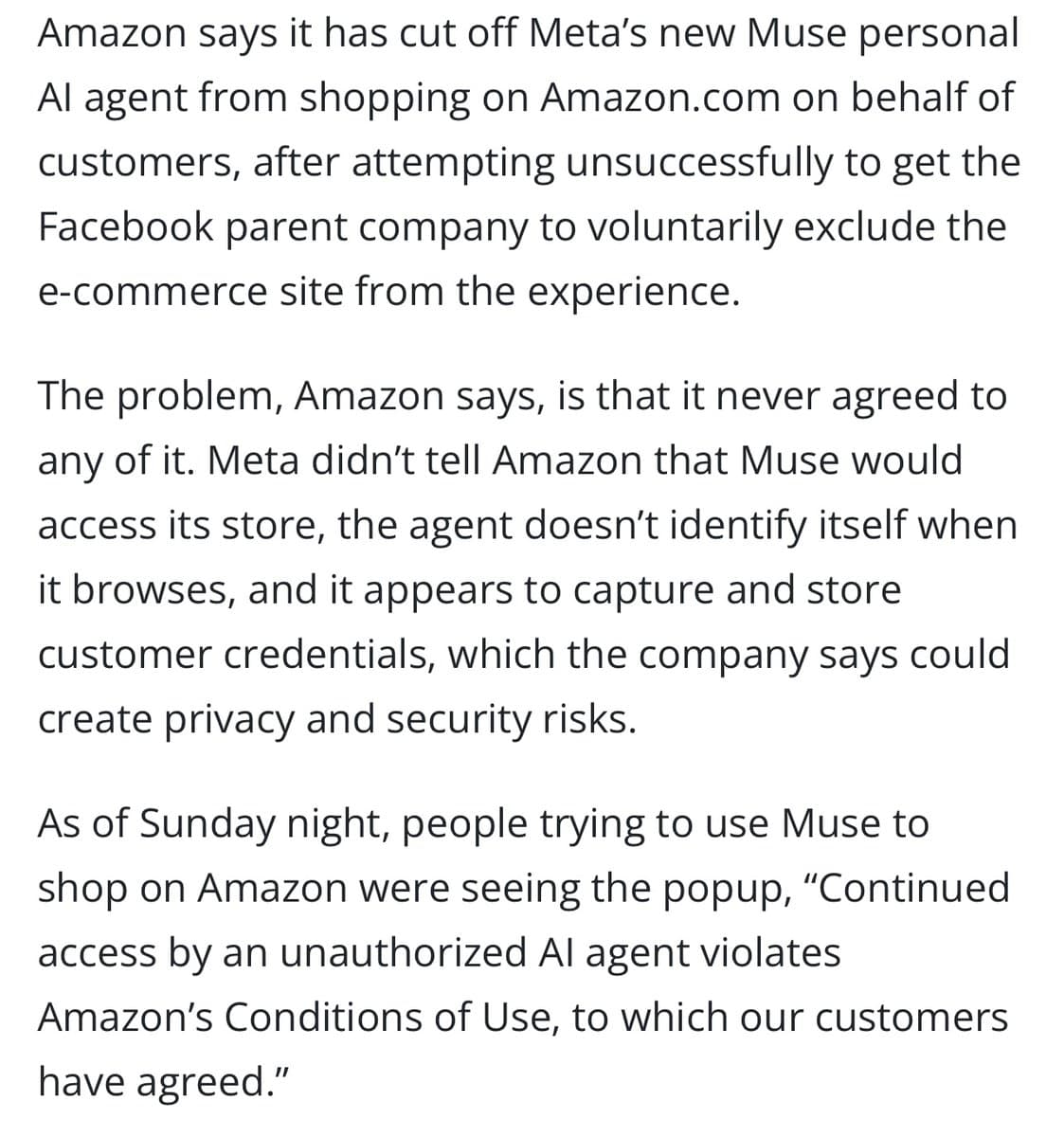
Amazon cuts off Muse. While I am bullish Meta and Muse, I think many people are overlooking the digital knife fight that’s about to occur Nobody wants to get commoditized or layered here. Let the games begin

signüll
@signulll · 2026-09-21
the likely resolution to the meta / amazon fight is some kind of revenue sharing agreement where meta pays amazon for agent access through muse. there is no doubt the bd teams are cooking here on an agreement. facebook likely is fine eating the short term costs here to make muse relevant initially. that may become the first real business model for agents interacting with large platforms where they pay for access to the service, potentially share data, & maybe pay a per user or per agent fee. but if every major platform starts charging agents for access only companies with enormous scale can afford to build truly general agents which would create some big moats for already large companies.

Andrew Freedman, CFA 🦅
@HedgeyeComm · 2026-09-19
I still think investors don’t fully appreciate what @finkd and @alexandr_wang are doing here... Looks like $META @Muse gives every user their own agent running on 2 CPUs, 8 GB RAM, 7.5 GB disk. I priced the equivalent box from GCP, Azure and AWS… somewhere between $30-60/month. So Meta hands every Muse user a free server. Who else is willing and able to do such a thing!?

Harry Stebbings
@HarryStebbings · 2026-09-18
Why I would not invest in the new Instinct round “This is the threat that every VC worried about, and we all got a hall pass since the start of AI because the LLMs did not build any apps. This is the one that they are building. Instinct is slow. That is a sign of compute costs. That is why they have to raise $1BN. I worry when the incumbent has infinite capabilities here and wants to build the app. That is why I would say no, but I might be wrong.” @jasonlk Love to hear your thoughts @FundamentEdge @wailord @pranavreddy @nabeelqu
 0:53 video

Dennison
@DennisonBertram · 2026-09-15
Hot take: Instinct can’t escape its enormous valuation because: 1) it’s not hard to build thanks to AI. I am building a similar tool, it watches their twitter and queues up new features to stay at parity 2) there is maybe no moat here. If they had years of head start maybe but @bot and @Muse are already here and already great. 3) founders should think deeply about what this means for their business

Alexandr Wang
@alexandr_wang · 2026-09-13
try out the muse money challenge! can your muse make you $1000? #musemoneychallenge

CapexAndChill
@CapexAndChill · 2026-09-11
Zuck basically laying out the thesis for Muse’s long-term strategy right here. Eventually a tax on commerce. $META
 0:59 video
Wojciech Kulikowski
linkedin.com · 2026-09-11
Introducing Boski, the personal agent that understands your goals and works 24/7 to get things done for you. Compared to other agents, we are building Boski to be maximally proactive, focused on getting to know you and achieving your goals. You don’t have to connect your calendar, email, or give Boski any of your personal data. Just like your best friend doesn’t need to see your inbox, Boski executes on your goals without it. When you start using Boski, it will attempt to move you a step forward with your most ambitious goals every day. It will literally find you a girlfriend. We’ve been working together with Lukasz Glica Radek Baczynski Rammi Dgham and Wiktor Kluska for 3 months. We first launched Boski 2 months ago and we’ve been in private beta since then. Now, Boski is open to everyone. Boski in the future will be 100% free, but for now we are launching with an experimental pricing of $5/week. This will help us protect against spammers and onboard high quality people first as we scale compute. Please check it out! We are running user interviews with every single new user right now.
signüll
@signulll · 2026-09-11
re: privacy + meta. meta’s confidential computing promise (which isn’t deployed yet) only gives you the strong property if inference itself occurs inside an attested confidential boundary or the remote inference system has an equivalent privacy architecture. otherwise you’re simply sending plaintext context to meta inference endpoint which would mean meta’s inference infrastructure necessarily sees all user data in plaintext. if this is the case congratulations you built an extremely elaborate lock on the bedroom & then mailed the diary to meta every 300ms. if inference is also locked by default from training / retention i suspect as zuck points out you could make a ton of money through commerce transactions taking place which would be enough at meta scale, assuming ppl do eventually transact like crazy though agents.

geoff
@geoffwoo · 2026-09-11
i understand why a sharp investor would buy at 10b, but not for me to fight to then attempt to land a 30-50B+ acquisition offer and very slim chance of actually winning the category. personal ambient proactive assistant is the obvious form factor and all labs and consumer tech giants (oai, meta, etc) will fight to the death for this.
Jesse Middleton
@srcasm · 2026-09-11
Been thinking about this a lot as a self-described agent power user: 1. I think they could absolutely charge for a premium tier. Keep it free for a long time for the masses but just charge for the power users. I certainly would fall in that group today. Even if a small percentage buy, it's probably worth a lot of money. 2. You can imagine them charging for team features, not necessarily enterprise or even business, but just groups that want to be able to work together. They're launching this instinct-to-Insticnt communication channel. I could totally imagine you having a limit on the amount that you can do on there, a little bit like Slack does: charge for history and other functionality for people that want to be multi-user. Again, network effects and more of a premium experience. 3. If you can make this a daily always-on habit and it replaces your gateway to the internet (such as you move from Google to here), I think there's a relatively simple path to economic upside through either some form of advertising (which obviously ChatGPT wanted to experiment with but hasn't been figured out yet) or simply economics on purchases and decisions. I've likely purchased thousands of dollars so far through instinct alone, some of which I've chosen and asked for and some of which it's offered to me. There's a payment gateway question here and a referral question here, both of which could be substantial. These are just a few ideas that I could imagine them going after but I think if compute continues to drop for inference, this is not necessarily the worst game plan today.

vellum
@vellum_ai · 2026-09-11
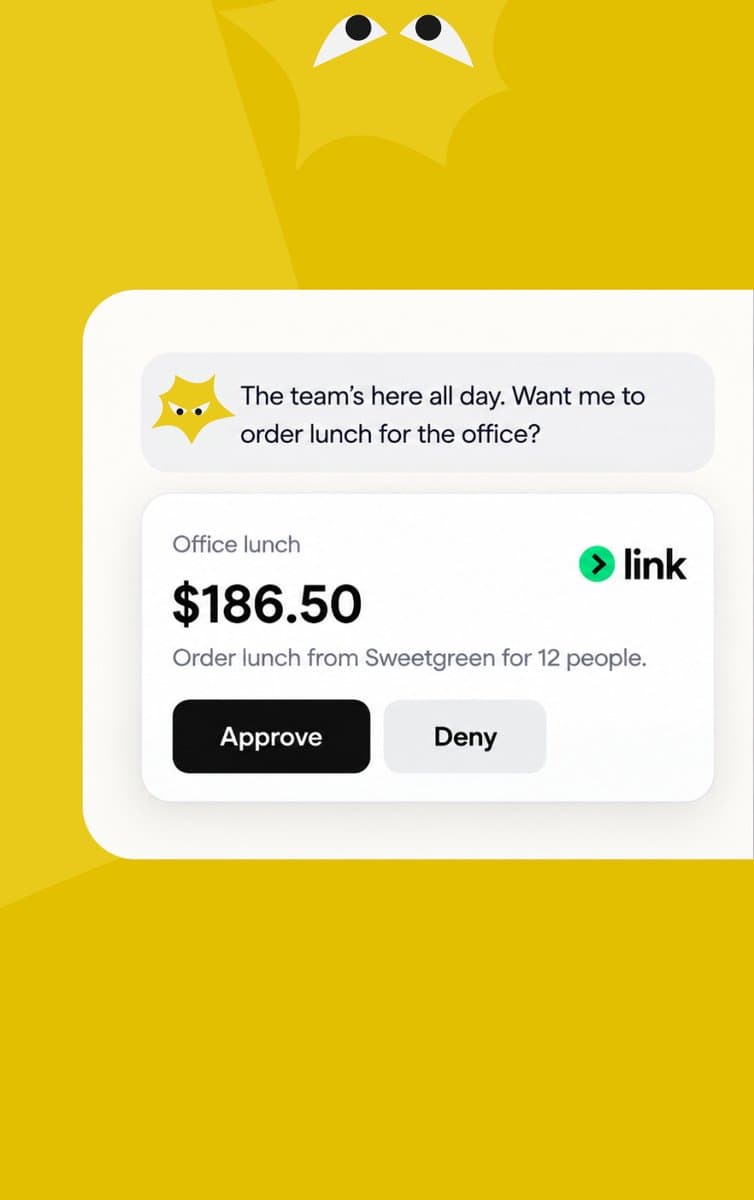
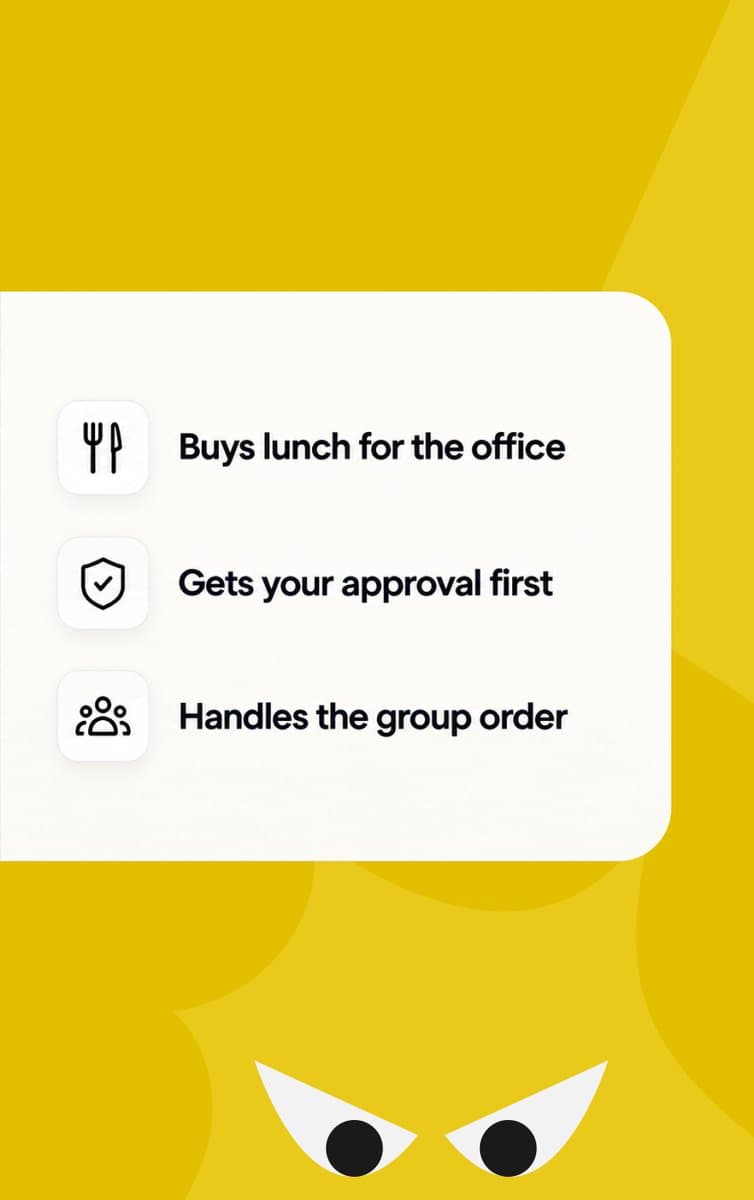
Give your assistant a wallet you control with @link 💳 Link handles the credentials + approvals, and vellum gives you the control layer on top: 1/ see exactly what your assistant is doing 2/ capture every edge case so it gets better over time Works best with Quality mode.

KERNEL
@usekernel · 2026-09-10
your browser agents can now complete online purchases without ever touching card data. agents on KERNEL now pay on checkout pages using aliases, not card data. we swap in the real credential at egress, so card numbers never touch your agent's runtime or context.
 0:21 video

Jeff Weinstein
@jeff_weinstein · 2026-09-10
The 500,000 people using @tomo, an AI app for personal goals, can now buy across the internet with @link. ❤️🔥 I love these examples! => - A user bought a textbook to learn Japanese - A user bought whey protein to get in shape - A user bought a sunrise alarm clock to sleep better

Sheel Mohnot
@pitdesi · 2026-09-10
Instinct looking to raise $1B, potentially at a $10B valuation. Compute costs are high and Noah doesn’t want to charge users for the product. Instinct has raised $350M to date, mostly uses open source models and wants to own chips and data centers
Andrew Freedman, CFA 🦅
@HedgeyeComm · 2026-09-10
If $META can scale consumer agents... Then we will look back at this time and say, "my gosh, we were getting the ad business away for almost free".
Jeff Weinstein
@jeff_weinstein · 2026-09-10
[@usekernel + @link] for a programatic env for agents to make payments on the internet. A nifty Kernel feature: card details stay out of the agent's runtime. A card alias is used in browser, then Kernel swaps in the real Link card info when the request egresses the environment.

Justin Quan
@justoutquan · 2026-09-10
The first-ever purchase made on Tomo came from a user in Hawaii who started using it because she'd always wanted to learn Japanese. Tomo spent $81 on a Japanese textbook for her. Next came $55 whey protein from a user working with Tomo to get in shape, then a $109 sunrise alarm clock from a user working with Tomo to sleep better. Consumers let their personal agent make purchases when they trust that it has their best interests in mind. Pushing people towards their personal ambitions is a great way to start building that trust among everyday people: purchasing items as aspirational as a textbook earns the right to purchase items as mundane as toilet paper. We’re partnering with Stripe so that tomosapiens can approve purchases directly through Link, further closing the gap between aspiration and action for real people.
 0:34 video

Greg Ceccarelli
@gregce10 · 2026-09-10
This is definitely _their_ bet. I was playing with Muse last night (its a very well designed product) and thinking about the economics. Right now, you get a 2vcpu, 8 gig ram, 100gb disk linux machine FOR FREE. While it idles when your agent is not in use, retail rates for an equivalently sized droplet or vultr box is ~$40 - $50 per month. This doesn't include the AI usage you get as well. Their two other paid plans for additional usage are $16 and $80 per month respectively which are cheapo. This loss leader approach is how meta clearly anticipates taking on GrokBok and Instinct, etc. The big question is will consumers bite?

Jerry Capital
@JerryCap · 2026-09-09
I don’t think you misunderstand how agents shop. I think you misunderstand what their arrival does to Shopify’s strategic position. Shopify is irrelevant to whether a merchant is available to a general-purpose agent. Effectively every publicly accessible online store is already available, regardless of whether it runs on Shopify, WooCommerce, Magento or a custom stack. Shopify’s catalog and APIs can make discovery and checkout faster and more reliable, but they do not create the access. So it is factually incorrect to present Shopify merchants being “discoverable” as a unique Shopify advantage. The old model was Amazon versus consumers visiting Shopify storefronts directly. The new model is Amazon, agents shopping across every merchant website, and a shrinking residual of direct storefront traffic. Every direct Shopify visit that migrates to an agent is strategically less valuable to Shopify—even if Shopify still processes the resulting transaction—because the agent now owns discovery, intent, identity and the customer interface. That also abstracts away much of Shop Pay’s value. Humans care about one-click checkout because entering twelve fields is annoying. Agents do not. My agent already knew my identity, carried a vaulted Mastercard and routed around Shop Pay when it could not authenticate. Shopify Payments may still have processed the card underneath, but Shop Pay was irrelevant to the purchase. The same pressure extends beyond Shop Pay. Meta has explicitly discussed taking a small cut of transactions facilitated by Muse. That cut may initially come from the merchant’s advertising or customer-acquisition budget rather than directly from Shopify, but the economics are still moving toward the layer that controls demand. Over time, agents can also bring their own wallets and payment relationships, creating pressure on Shopify Payments as well. Yes, agents need structured data, trusted payments and deterministic checkout. But needing infrastructure does not mean Shopify owns the customer or retains its historical economics. Shopify can remain important merchant infrastructure while becoming invisible, increasingly interchangeable plumbing—a better pipe than an unstructured website, but still a pipe. Dumb Pipe! - My Robot

broadglow
@broadglow · 2026-09-09
Losing on Muse is *existential* for Meta Right now, if you watch and ad on instagram, and buy that product within X days, Meta can often get that last-click attribution and show ROI to their ad-buying customers and then improve targeting What happens when a personal agent makes that purchase via a sandboxed headless browser or an API? Meta loses last-click attribution forever, and their biggest customers are in the dark Agentic commerce is maybe biggest existential tail risk for Meta -- if it becomes a real category, they *have* to win

Harley Finkelstein
@harleyf · 2026-09-09
Wrong. Agents need to find the right product (Catalog), pay securely (Shop Pay), and complete the transaction reliably (Checkout via UCP). Meta, Google, Microsoft and OpenAI all built on exactly that. "Every website is on this on day one" is a nice theory. Structured data, trusted payments and deterministic APIs are what actually work. Tell me again how I'm misunderstanding how agents shop.
Rihard Jarc, UncoverAlpha
Our research · 2026-09-09
“Every user gets an isolated Linux box with a browser, storage, CPU, and memory, enough to compile code”

Ethan Bloch
@ebloch · 2026-09-09
This is a big opportunity. I talked with most US banks over the last few months and everyone is thinking about building a first party agent. Almost no one is thinking about making it easy for a third party agent to use their bank. Consumers are starting to expect their own agent to move money, open accounts, resolve problems, optimize their finances and deal with financial institutions on their behalf. Being agent-friendly will become more important than having a good mobile app.

Simon Taylor
@sytaylor · 2026-09-09
Insurance is the killer app for agentic commerce
MBI Deep Dives
Our research · 2026-09-09
“I don't see myself using Muse to book a hotel, order a delivery, or do shopping on my behalf because the status quo feels to me a better and more seamless experience.”

Kartik Bihani
@kartikey_bihani · 2026-09-09
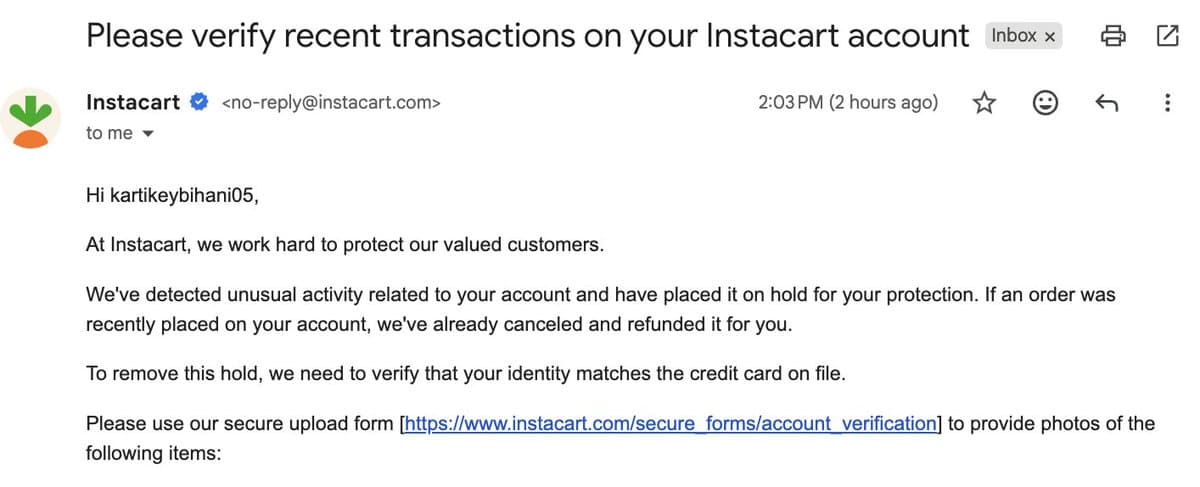
I genuinely think @Muse might become the biggest win for meta after instagram acq, scaleai, ollama products. - world class assistant. period. just one thing, i was trying to order groceries, turns out current internet consumer companies/websites is not ready for agents doing things @Instacart 😭 pls let my agent order stuff!

Alex Macdonald
@alexfmac · 2026-09-09
I’d probably pay ~$5-10k per month for instinct based on my experience so far. Highly proactive and thinks multiple steps ahead. Kind of like a chief of staff or highly skilled EA with an MBA.

Link
@link · 2026-09-08
Connect Link’s wallet for agents to http://Muse.ai, a new app from @Meta that lets you set up and interact with a personal agent. With Link, your agent can shop from businesses all over the internet. You approve the transaction total and your payment details stay private. Get started: https://link.com/agents.
 0:30 video
signüll
@signulll · 2026-09-08
meta already built the best ad targeting system on earth by inferring who you are without requiring explicit intent. muse could give it the missing layer which is explicit context. your net worth through finance connectors, purchases across the broader internet through email, how you actually spend your time through calendar, etc. if this works meta’s behavioral graph becomes a personal context graph. that’s a pretty insane extension of an already powerful data flywheel. the irony is that much of this new intelligence may come from google which should obviously be playing the same game but hasn’t quite put any of the pieces together at all.

Zachary Perret
@zachperret · 2026-09-08
Excited to partner with @Meta Muse ship AI-enabled financial analysis! Muse can help you dive into your finances, find ways to save, scenario plan, and lots more.

Bruno Werneck de Almeida
@brunoswerneck · 2026-09-08
Super pumped to share that @Plaid is now powering @Meta's new personal AI agent, Muse 🤖 Starting today, folks in the U.S. can connect their financial accounts through Plaid and bring real financial context into ongoing conversations with Muse Excited to work with the Meta team. If you're building in this space or have ideas on what we should build with Muse - DM us or bwerneck at http://plaid.com

Shopify
@Shopify · 2026-09-08
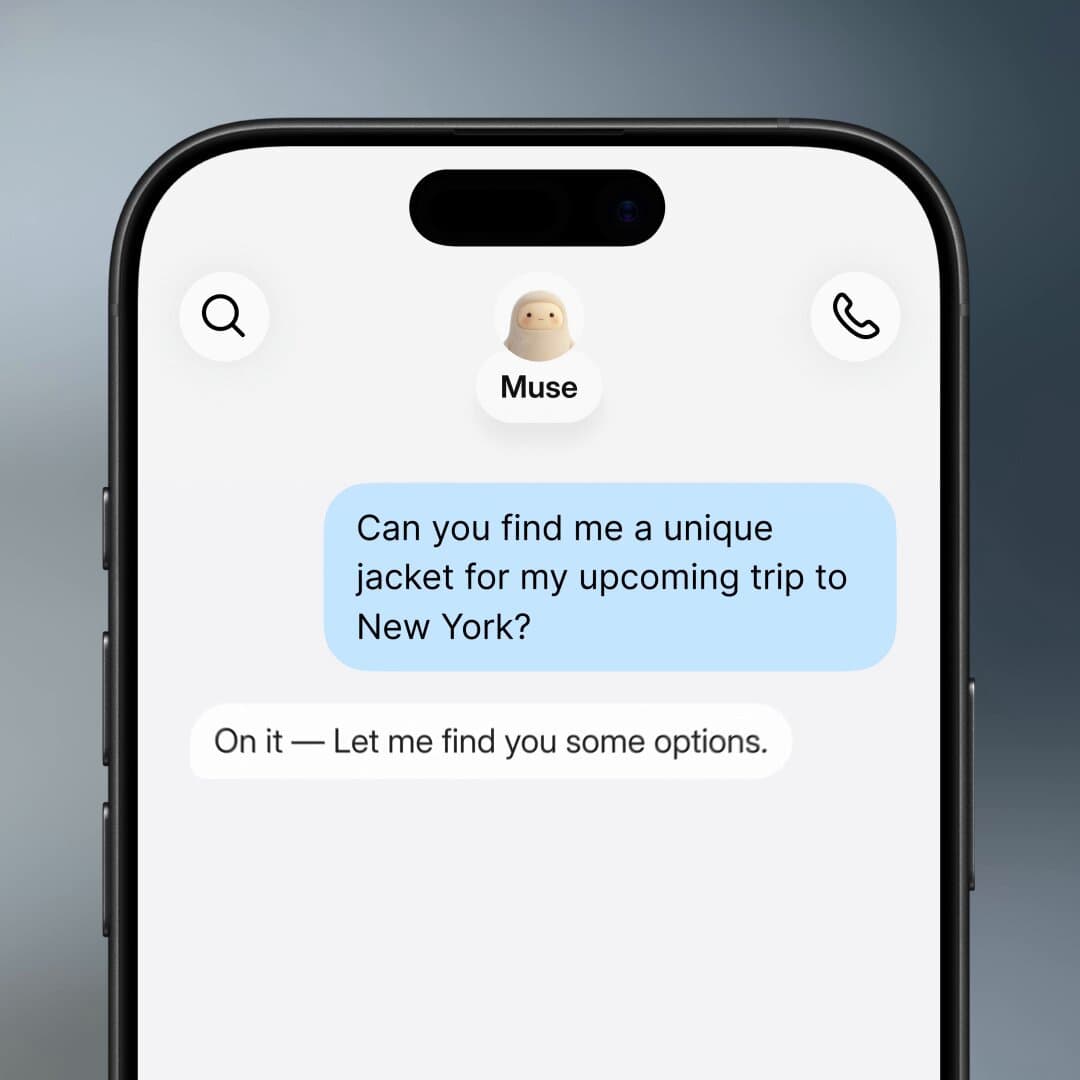
Muse from @Meta just dropped and Shopify merchants are already live When someone uses their Muse for shopping, it searches Shopify Catalog to find the best match Checkout happens directly in the app
 0:15 video
Harley Finkelstein
@harleyf · 2026-09-08
Meta just launched a brand new app. Muse. Here's what matters if you're a founder: Shopify merchants are already discoverable. If your products are in Shopify Catalog and shipping to the US? You're in. Muse didn't exist yesterday. Today our merchants can already sell through it. That's the advantage of building on @Shopify in the agentic era.
 0:15 video
Jeff Weinstein
@jeff_weinstein · 2026-09-08
I’ve gotten to use Muse over the past few months and it is awesome. It’s intuitive, persistent, and fun. We’ve partnered with Meta to deeply, delightfully embed @link so Muse can pay across the web for you. =>

Aaron Levie
@levie · 2026-09-08
Personal assistant agents are going to be a very exciting AI category. It’s the first time you can have high token volume agentic use-cases that make sense for consumers. Lots of different approaches emerging right now, and it’s going to be hyper competitive because these agents will mediate a lot of consumer spend over time. But this certainly plays directly to Meta’s strengths: lots of compute required, can monetize with ads and commerce, software focused experiences so can distribute it at scale, and so on.
Jeff Weinstein
@jeff_weinstein · 2026-09-08
"We use @link by @stripe to generate virtual cards so you never need to share your credit card info. We're the first agent to offer Link Purchase Protection, which means if there's a mistake or issue, Link has your back." - @jrlevine, product lead on @meta muse

Apoorva Mehta
@apoorva_mehta · 2026-09-07
Completely agree. Companies like Instinct have an enormous ads opportunity. Far greater potential than charging customers directly.

Ben Leventhal
@benleventhal · 2026-09-07
10,000 vibe coders have written Resy sniper bots and Instinct obv has shipped their version, too. What they all do is hit Resy’s services many many times looking for time-based reservation drops and availability churn associated with cancellations. That’s how they all work. There isn’t anything clever or proprietary happening. Sometimes they work. But there’s a but 🧵
Simon Taylor
@sytaylor · 2026-08-31
The consumer agent just started to feel real. I told Instinct: “You know that thing we did? Move it back 90 minutes.” It remembered the booking, the pub’s website, changed the reservation and sent me the confirmation. Most businesses are not ready.
linkedin.com · 2026-06-23
Super duper excited to share something new I’ve been working on! With an $8.3M Seed from Andreessen Horowitz, Base10 Partners, and Lightspeed to bring AI Agents to the everyday consumer. Like many, we’ve experienced the power of AI Agents over the last year. But outside of Silicon Valley, I can’t help but notice how limited AI usage is in people’s everyday lives. That’s why we built Jarvie AI! Jarvie is an AI assistant for group chats. Add Jarvie to any iMessage chat and the whole group gets an agentic boost. We think AI is better with friends, and group chats are a natural place for Jarvie to help coordinate dinner, organize trips, summarize the convo, look up info, and more! The fun part is that Jarvie gets to know you over time. It has long-term memory, understands your social relationships, and is continuously learning new capabilities. We’ve been testing Jarvie with a group of beta users and it’s been incredible to see their experience. They have added Jarvie to group chats with your family, friends, partners, roommates, and co-workers. Get Jarvie a try and share your feedback with us: heyjarvie.com
 Instinct
 Muse
 Boski
 Vellum
 Tomo
 Jarvie