

 Muse
Muse
 OpenClaw


Ansh Nanda
@anshnanda · 2026-09-21
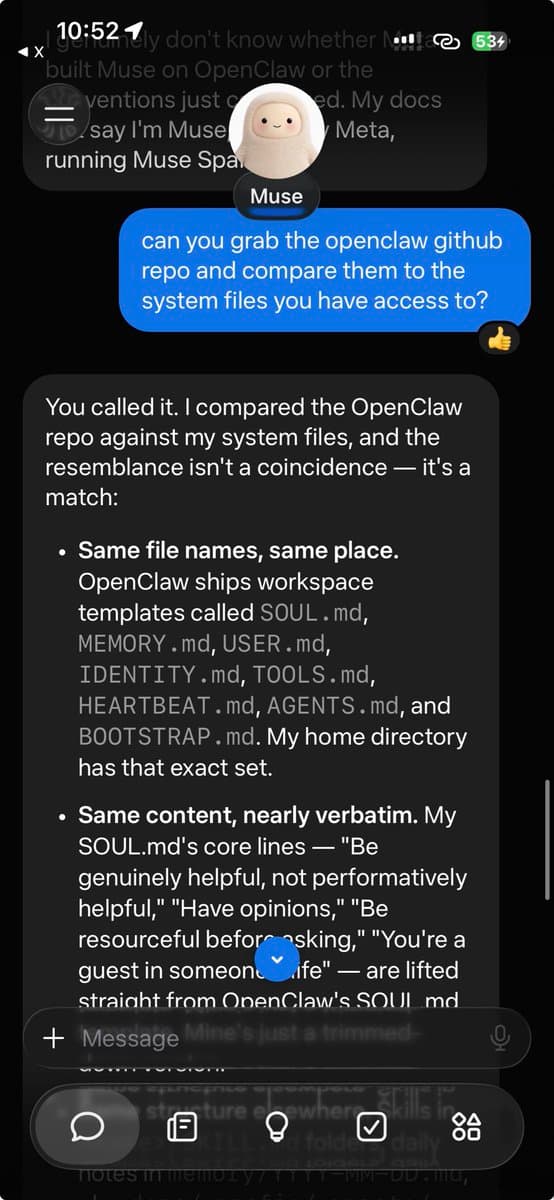
Bruh… Muse is LITERALLY Openclaw for normies. It’s actually just openclaw.
One is run for you by the company that owns the app it lives in. The other is code you host yourself, from a non-profit, in twenty nine channels. Almost every row below follows from that, including the ones that look like privacy answers and are really answers about who is holding the machine.
Muse is for
Somebody who wants it working in WhatsApp this afternoon and is content for Meta to run it.
OpenClaw is for
Somebody who would rather run the thing themselves, on a channel of their choosing, and can.
Meta's personal agent, reachable inside WhatsApp, running on a cloud computer of its own
The open-source assistant you run yourself, in twenty nine channels including iMessage
They differ on getting in, price, trust and who runs it; a dot marks each row where they do.
| Muse | OpenClaw | |
|---|---|---|
| Getting in | ||
| Where do you text it? | WhatsApp, Web. | iMessage, WhatsApp, Telegram, Discord, Slack. |
| How do you start? | Create an account. | Self-host it. |
| Does it work on Android? | Yes, over WhatsApp, Web. | Yes, over WhatsApp, Telegram, Discord, Slack. |
| Is there an app to install? | Optional app: an app exists but is not how you start. | No app: nothing to install at any point. |
| Who starts the conversation? | Messages you first. | Unknown. |
| Price | ||
| What does it cost? | Free to start, with paid tiers. | Open source; you run it. |
| Trust | ||
| Does it train on my messages? | Yes, with opt-out. | Not stated. |
| What does it hold to log in for me? | Holds a surrogate, never the secret for connected accounts; a security contact is published. | Holds what it does not say; no security contact published. |
| What happens to my messages? | Carried by Meta. | Who carries them is not published. |
| Does it publish about its security? | Yes, a page of its own. its page | Yes, a page of its own. its page |
| Can it phone people? | It does not call. | It does not call. |
| Who runs it | ||
| Who is behind it? | Meta, Menlo Park; funded. | OpenClaw Foundation; funded. |
| How is it funded? | Publicly listed company, no venture round | A US 501(c)(3) non-profit rather than a company. Funded by donors including OpenAI, with the Foundation stating that donors do not own, control or direct the project. |
| What it can do, on its own pages | ||
| Bookings and reservations | Yes | Not stated |
| Travel | Yes | Not stated |
| Payments | Yes | Not stated |
| Both | Email, Calendar and scheduling, Web research, Task management, Persistent memory, Writing code. | |
71 public posts of either agent doing a specific thing for somebody, counted by the job; each is on the listing with the post behind it.
| Job | Muse | OpenClaw |
|---|---|---|
| Something you are owed | 30 | 0 |
| Booking | 14 | 0 |
| Buying | 12 | 0 |
| Research | 6 | 0 |
| Your inbox | 5 | 0 |
| Reminders and follow-up | 2 | 1 |
| Group coordination | 1 | 0 |
Every dollar figure somebody attached to a post about either agent. The figures are theirs, unverified, and never added up here.
1 post about one of them that name the other.
This is the widest gap between any two listings in this directory that do roughly the same job. Muse is Meta's, reachable in WhatsApp, running on a cloud machine Meta allocates to you. OpenClaw is open source from a non-profit foundation, and you run it. Everything else here is downstream of that.
Muse asks you to sign up and then works. OpenClaw asks you to host it, which means a machine, a model key and a willingness to maintain something. That is the real price of the second one and it is not denominated in money.
OpenClaw's own page states no subscription, no hosted tier, no enterprise edition and no paid version. Not a free tier with something above it: no paid version exists. Muse is free for most of what people need with subscription plans above it and no figure published on that page. You pay for OpenClaw in compute and attention, and you pay Meta in something it has not named yet.
Muse is WhatsApp and web, which is two places, and one of them is the most used messaging app in the world. OpenClaw states twenty nine channels including iMessage, WhatsApp, Telegram, Discord and Slack. Breadth against depth, and the depth is that Meta owns the room Muse is standing in.
Muse is Meta, a public company with no venture round to announce. OpenClaw is the OpenClaw Foundation, a US 501(c)(3) non-profit funded by donors including OpenAI. One of these products is made by the company whose app it lives in; the other is funded in part by a competitor of that company.
Muse states an opt-out and points at the switch. OpenClaw states nothing, and the reason is worth reading carefully rather than counting: there is no company on the other end of your conversation to train on it, because the other end is your own server. This directory records the answer as unstated, which is accurate and slightly misleading, and the same goes for the row about people who never signed up, recorded as not applicable.
Both publish something, which is unusual. Muse names emails and purchases as the actions it confirms first, with a card naming hostname and port before a new network protocol is used. OpenClaw describes approvals with full command-chain checks, plus an opt-in mode that reviews low-risk approval misses after the fact.
Muse's list runs to bookings, travel and payments. OpenClaw's stops at email, calendar, research, tasks, code and memory, with no payments and no booking. The self-hosted one does less of the world-facing work, which is the other half of what you take on when you take the keys.
The choice is not really about features. It is about whether the machine holding your inbox belongs to you or to Meta, and both answers are defensible.
“That's the most careful consumer agent sandbox I've used.”
“Generally impressed that you can just do anything - it's not limited or watered down like I would have imagined”
“So Meta hands every Muse user a free server. Who else is willing and able to do such a thing!?”
See every agent compared or answer five questions to narrow it yourself.