Things it watches for you
8 public posts of somebody having an AI agent they text handle things it watches for you, from 8 people, on Muse and Instinct. 1 of them posted a figure, $200 to $200, each the author's own. None reports going wrong; people post successes.
A standing job is the thing a person cannot do: check the same page twice a week, every day, forever. The school portal twice a week for missing assignments, which its user called the killer use case. Four children's schedules across four messaging apps, read every day and sent as one notification. The delivery email in a Gmail tab nobody opens. A Marketplace listing for a price drop. A feed of X, deployments, meetings and news as a morning report. An investor's five standing jobs, and an analyst's every trade benchmarked against the index from the day it was made. What these have in common is that the agent messages first, which is the row this directory records as proactivity, and the one an app on a phone cannot do without being opened.

 Muse
Muse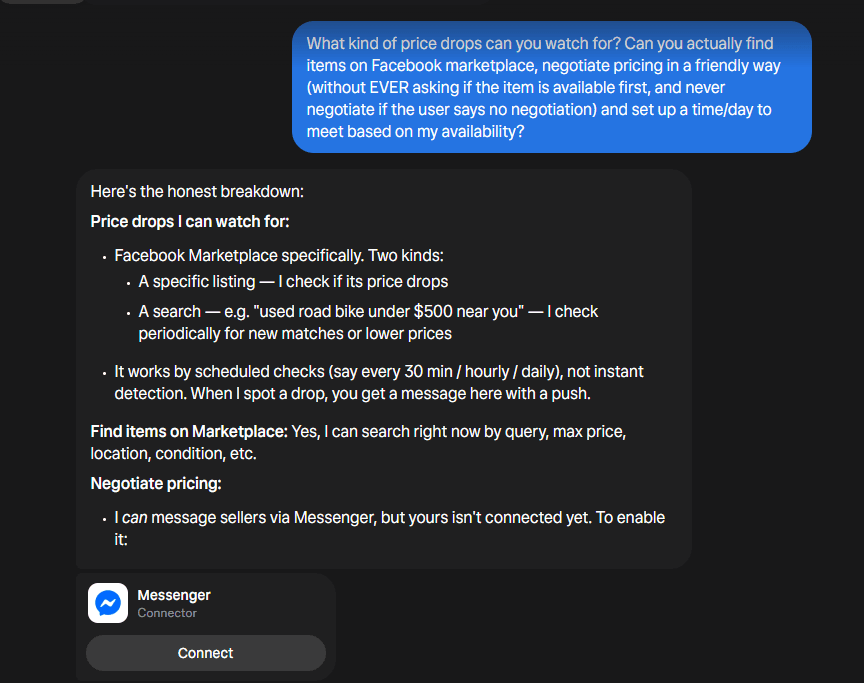
 Instinct
The figures, as posted
Every dollar figure somebody attached to one of these posts. The figures are theirs, unverified, and never added up here.

Muse

Instinct
- $200earnedin gift cards so far, from demos it bookedMuse
The posts, by agent
Muse
A founder says Muse's feed gives him a daily report of his X timeline, his feature deployment status, his meetings and the news, with everything he uses connected to it, and that he does not know why nobody else has built it.
Why it is notable
The first sighting of the feed as the thing somebody values rather than a task done: one daily brief across four sources, two of them personal and two public. It is a standing watch, the shape several listings sell as the morning brief, here from the product that also does the errands.
Posted by a user by Alex Klarfeld (@AlexKlarfeld): x.com, 2026-09-18. Added 2026-09-19.
A father of six with four children in four sports across four messaging apps has Muse watch the schedules and send a daily notification laying out everyone's day. He says he is not technical and setup was easy and free.
Why it is notable
A standing job rather than an errand, reading four apps the parent could not keep up with. The family calendar is the use case the group-chat listings here sell, done from one person's phone.
Posted by a user by To My Children (@toallmychildren): x.com, 2026-09-11. Added 2026-09-17.
- WhatsApp
A user connected Muse to Instagram and asked it to steer the feed towards companies that give away products and gift cards for sitting through a demo. Muse found them, signed the user up and put the calls on the calendar; the user reports three pairs of AirPods and a $200 gift card so far, with more demos found for the following week.
Why it is notable
It is an entry in a challenge Meta's chief AI officer launched the same night, #musemoneychallenge, which asks whether your Muse can make you $1,000, so it is a user's post inside a company's campaign, and filed as both. What it shows about the product is specific: the agent changed what a feed shows, then booked the things the feed surfaced, which is the Instagram graph doing what no other listing here can reach.
Posted by a user by kanha korgaonkar (@KORGAONKAR): x.com, 2026-09-13. Added 2026-09-13.
An investor named his Muse agent Alfred and gave it five standing jobs: watch X for the investing topics and tickers he follows, transcribe and summarise podcasts, run a daily news check on the names he covers, watch for proposed regulation and litigation touching his watchlist, and write a morning macro summary. Posted in reply to Meta's chief AI officer saying to use Muse for investing.
Why it is notable
Five recurring monitors rather than five one-off tasks, which is the second published account in two days of Muse doing standing research for an investor, after the trade-alpha dashboard. The jobs are all reading and summarising; nothing here buys, books or logs in anywhere, which is the part of the product every account so far says works. The prompt came from Meta itself, and the reply is the first outside record of somebody taking it up.
Posted by a user by SouthernValue (@SouthernValue95): x.com, 2026-09-11. Added 2026-09-11.
- Web
An equity analyst had Muse read his trade confirmation emails, benchmark every buy and sell against the S&P 500 from the day of the trade, and plot the notional-weighted alpha over time, with a per-trade view. He used to keep the same journal in a spreadsheet and stopped because the trades had to be typed in.
Why it is notable
The job was abandoned by hand and revived by the agent, which is a cleaner argument for the category than any demo of booking a table. It also shows what a mailbox connector is for beyond triage: the inbox as a data source, and a dashboard built from it in the app rather than a reply in a thread.
Posted by a user by Mostly Borrowed Ideas (@borrowed_ideas): x.com, 2026-09-10. Added 2026-09-11.
- WhatsApp
A user asked Muse what it could actually do on Facebook Marketplace. It offered to watch a specific listing or a saved search on a schedule, to search by query, price, location and condition, and to negotiate with sellers over Messenger once that connector is turned on. No purchase was made: this is the agent describing its own reach when asked.
Why it is notable
Two limits arrived unprompted, which is what makes it worth recording. The watch runs on scheduled checks rather than instant detection, so it is not a bidding war tool, and it cannot message a seller at all until Messenger is connected. Both are the sort of qualification a marketing page states as a capability without the caveat, and both come from the agent itself rather than from us.
Posted by a user by Loktar (@loktar00): x.com, 2026-09-08. Added 2026-09-09.
Instinct
- iMessage
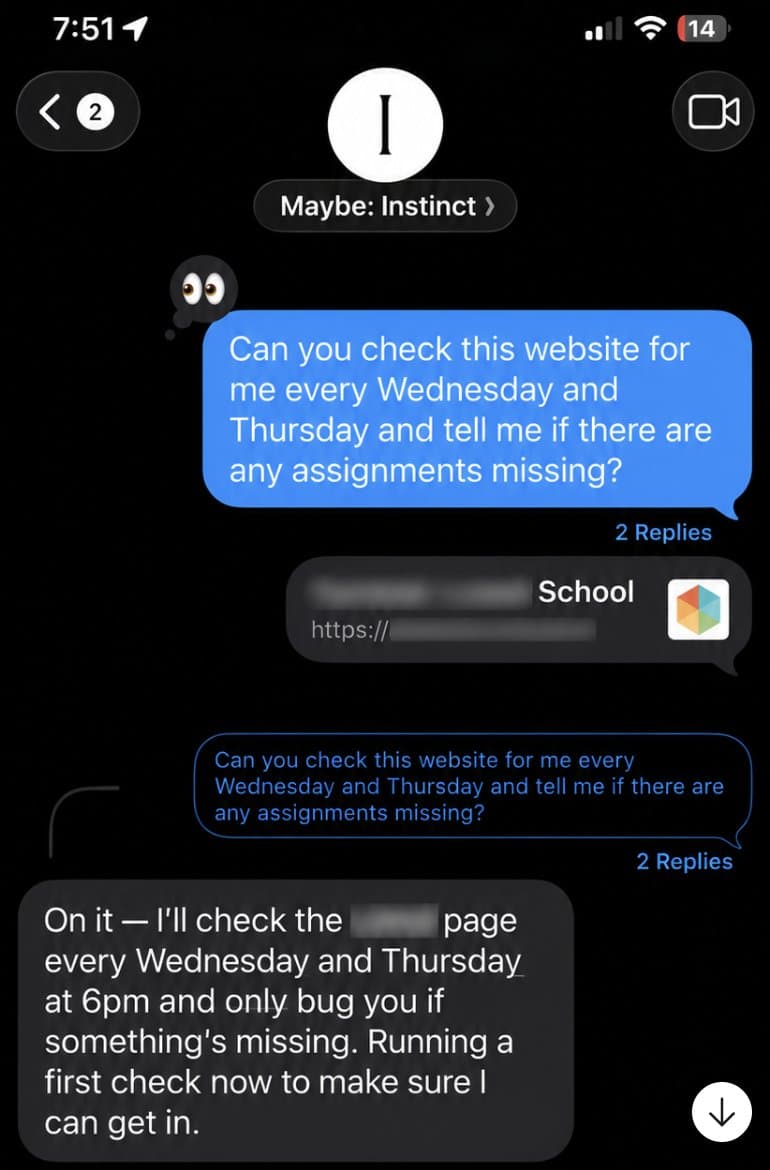
A user set Instinct to check her children's school portal twice a week for missing assignments and report back, and called it the killer use case. A parent's portal is a login, a page that changes, and a question nobody wants to remember to ask; the agent asks it on a schedule.
Why it is notable
It is the plainest example here of what a scheduled check is for: not a reminder to do something, but a thing done and a report of what changed. It also needs the school portal's login, which on this listing is a password handed to the agent, the arrangement its policy describes and most of this directory does not allow.
Posted by a user by Deirdre Bosa (@dee_bosa): x.com, 2026-09-12. Added 2026-09-12.
- iMessage
A user in San Francisco has Instinct watch the delivery email that lands in his Gmail Updates tab, where he never reads it. While he was away with family it told him a parcel had arrived, then offered to text the apartment he was staying in to ask whether someone could bring it inside.
Why it is notable
The interesting part is not the notification, it is what the agent said next. Asked whether the parcel had actually arrived, it separated the carrier's claim from the fact, said there was no delivery photo and no porch note, and told him what would settle it. An agent that volunteers the limit of its own evidence is doing something no features page describes, and it is the behaviour that decides whether an unprompted message is worth having.
Posted by a user by Advait Marathe (@AdvaitMarathe): x.com, 2026-09-08. Added 2026-09-09.